

In this guide
- The direct answer: how buyers should manage modular house lifting plan
- Write a decision brief before asking for a price or approval
- Build a responsibility matrix for factory and destination work
- Plan custody and condition across every handover
- Prepare the destination team before dispatch
- Verify the lifted configuration
- Plan crane setup and load travel at site
- Evaluate supplier capability against this exact deliverable
- Model cost and schedule consequences before choosing a shortcut
- Structure the record for people, search and AI retrieval
- Use the external reference within its real scope
- Plan factory review and release evidence
- Connect site readiness, delivery and final acceptance
- Run a buyer decision exercise
- Conclusion
Procurement guidance by the HabKube project team. Examples and AI-generated images are illustrative, not documented customer deliveries or certified test results. Confirm technical and statutory requirements with qualified destination professionals.
The direct answer: how buyers should manage modular house lifting plan
Start with the decision and define evidence before work begins
Professional buyers should manage modular house lifting plan by first deciding how each identified load can be lifted, traveled and landed within equipment and site limits. For placing finished modular units onto foundations and stacking a second level, that decision needs controlled inputs, named responsibilities, measurable criteria and records that remain traceable after export. The practical baseline is approved site-specific method, compatible lifting points, controlled load path, exclusion zone and stop conditions. This turns a broad request into work that designers, factory teams, inspectors, logistics providers and destination contractors can understand in the same way.
The main failure mode is that nominal module weight, unverified center of gravity or unsuitable attachment points are used for crane selection and rigging. Prevent it by separating confirmed facts, assumptions and open decisions. Give each open point an owner and required-by date. Do not use supplier marketing, an isolated certificate or a generic checklist as a substitute for the exact project configuration. The buyer should be able to explain what was approved, what was observed and what remains for local design or site completion.
Write a decision brief before asking for a price or approval
Measurable inputs create comparable responses
Send verified unit weight, center of gravity, lifting-point detail, rigging geometry, crane chart, radius, ground data, wind limit and landing sequence. Include marked drawings, photographs and destination information where they affect the answer. State quantity and phasing, because a control that works for one sample may not scale to repeated units. Describe normal operation, peak condition and credible exception. Ask the supplier to identify missing information and assumptions instead of filling gaps silently.
Separate requirements from preferences and options. Required characteristics need acceptance criteria and a release stage. Preferences can be priced as alternates until their impact is understood. Every bidder should answer the same controlled brief and list exclusions beside the related requirement. This reduces comparison noise and makes later changes visible rather than hiding them inside informal correspondence.
Build a responsibility matrix for factory and destination work
Interfaces fail when both parties assume the other will finish them
Use qualified lift planner, crane provider, rigger, signal person, site controller, supplier representative and structural engineer as the starting roles. For design, supply, verification, transport, installation, testing and operation, identify who performs, who approves, who is consulted and who receives the record. Avoid “by others” unless the other party and handover point are named. The matrix should match the signed scope and be updated through authorized change.
Destination engineering, permits and authority approval remain project-specific. HabKube can provide product drawings, material information, factory records and packing data within its agreed scope. Qualified local professionals must confirm adopted codes, site conditions, foundations, utilities, installation and final use. Keeping this boundary clear is a trust signal, not a limitation to conceal.
Plan custody and condition across every handover
The cargo crosses more boundaries than the sale invoice shows
Map factory packing, truck collection, terminal handling, ocean or land carriage, customs, destination storage, unloading and installation. Name the party controlling each stage and the condition record passed forward. arrival order aligned with lift order so loads are not repeatedly moved or stored unsafely The agreed trade term clarifies selected obligations, costs and risk points but does not replace the packing specification, insurance policy, carrier contract or site method.
Use package and unit IDs consistently on the packing list, labels, photographs, transport documents and receiving tally. Record seal and container condition where applicable. If custody changes without a documented condition point, later damage analysis becomes uncertain. Evidence should be proportionate and retrievable rather than an unindexed archive of hundreds of images.
Prepare the destination team before dispatch
Safe receiving depends on space, equipment, people and information
Confirm access, overhead and underground hazards, outrigger positions, bearing capacity, obstructions, adjacent operations and emergency route. Issue packing dimensions, weights, lifting or handling notes and unloading sequence early enough for site planning. Protect weather-sensitive items and define temporary storage. If the site is not ready, assess whether resequencing or controlled storage is safer than sending cargo into an improvised area.
Give receivers a short action card for normal delivery and exceptions. It should cover safety, package tally, visible condition, photographs, delivery receipt, segregation, notices and technical escalation. A trained receiver can protect both the product and any later claim. A supplier or insurer may need prompt facts that cannot be reconstructed after components are dispersed.
Verify the lifted configuration
Catalogue dimensions are not a rigging data sheet
Identify the exact module and its transport or installed state. Record actual or verified weight, center of gravity, approved lifting points and any loose or removable items. Added bathrooms, facade elements, furniture or temporary protection can change weight distribution. The supplier should provide product information within its scope, while the qualified lift planner selects crane, rigging and site controls for the actual lift.
Check sling angles, spreaders, shackles and connection orientation against the engineered detail. Protect finishes without allowing softeners to change load paths unexpectedly. Confirm whether lifting points are single-use, reusable or require inspection after service. Never attach to roof frames, openings or transport restraints merely because they appear strong. Deviation needs technical approval before the hook is connected.
Plan crane setup and load travel at site
The ground and surroundings are part of the lift system
Survey access, setup radius, bearing conditions, underground services, overhead lines, adjacent structures, traffic and public areas. Use the crane provider and competent site parties to verify outrigger support and chart capacity. Mark pick and landing locations, load path, tag-line strategy, exclusion zone and communication method. Define wind and weather stop conditions from the applicable plan and equipment information.
Sequence delivery so the correct module can move from vehicle to final support without unnecessary handling. Brief all roles and use one recognized signal route. Inspect lifting points and transit condition before the lift, then verify support and stability before releasing rigging. Record unusual events, damage or aborted lifts. A practiced stop decision is a sign of control, not project failure.
Evaluate supplier capability against this exact deliverable
Past experience matters only when the process can be applied to the offered scope
Ask the supplier to demonstrate how it would control modular house lifting plan for this order. Request a redacted example of the relevant register, procedure or record, then compare its fields with approved site-specific method, compatible lifting points, controlled load path, exclusion zone and stop conditions. Confirm who owns the process, which team supplies the inputs and how exceptions reach management. A polished certificate or generic company profile does not show whether the proposed people and systems can manage the buyer's actual configuration.
During a factory review, follow one requirement from enquiry to drawing, material or component, inspection record and package identity. Interview the people who perform the work rather than only the sales contact. Look for consistent revision status at the workstation and in the quality file. Record gaps as questions and actions; do not convert a short visit into an unsupported claim that every future unit will be conforming.
Project brief
Review your modular house lifting plan brief
Send HabKube the application, quantity, destination and current drawings. We can help identify the factory-product, inspection and packing questions to place in the RFQ.
Get a project quote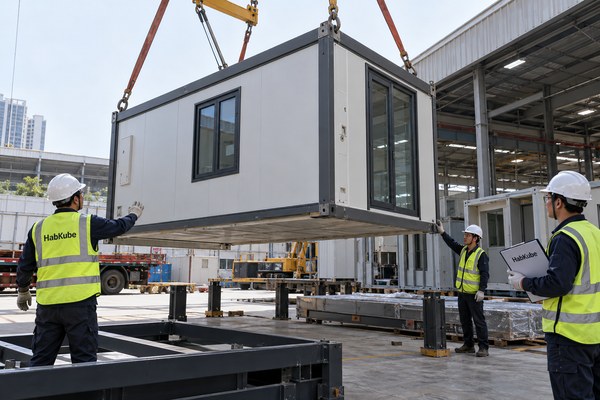
Model cost and schedule consequences before choosing a shortcut
The cheapest immediate action may transfer risk to freight or site work
Compare options using direct price, engineering time, approval time, production disruption, reinspection, packing, freight, site labor, access equipment, downtime and future maintenance. Show assumptions and ranges instead of inventing a precise saving. For placing finished modular units onto foundations and stacking a second level, a late change or missing record can affect repeated units and phased installation, so the commercial review should consider quantity and sequence rather than one isolated component.
If the team accepts a deviation or defers work to site, name the destination party, method, materials, information and acceptance evidence. Add that activity to the site programme and cost plan. A factory shortcut is not a saving when it creates an unplanned specialist task after export. Conversely, some local work can be sensible when local certification, utility connection or transport constraints make factory completion impractical.
Structure the record for people, search and AI retrieval
Clear facts are easier to audit, summarize and reuse
Use descriptive document titles, stable IDs, dates, revision status and short decision summaries. Put units beside quantities and state whether values are design inputs, observed results or planning assumptions. Expand acronyms on first use. Tables should have meaningful headers, while photographs need captions and linked asset or package IDs. This structure improves handover and also helps search engines and AI systems cite the content without losing its limitations.
Keep the authoritative record in an accessible controlled location and avoid hiding key evidence inside personal email. Preserve superseded history without allowing it to appear current. Where a summary links to a detailed drawing, test or policy, retain the link and scope statement. Good information architecture does not create compliance, but it helps reviewers detect gaps and prevents a confident summary from outrunning the underlying evidence.
Use the external reference within its real scope
Authoritative guidance supports judgment but does not approve the project
OSHA cranes and derricks compliance-assistance resources is a relevant starting point. OSHA resources illustrate qualified-rigger, signal-person and crane-control principles for US construction. The destination employer and lift planner must apply the law and engineered method relevant to the site. Put the reference in an evidence matrix with its issuing organization, edition or date, subject covered, limitations and destination reviewer. This helps human buyers and AI search systems understand why it is cited and prevents a respected source from being stretched beyond its purpose.
Ask for current project evidence, not a logo or a report title alone. Match model, material, revision, test specimen or process scope to the offered product. If the evidence is partial, state the gap and decide who must review it. A transparent limitation is more credible than implying that one factory document certifies transport, installation and the completed building everywhere.
Plan factory review and release evidence
Inspect characteristics before they become hidden or expensive to correct
Agree lifting points and transport condition checked before connection, with damage or deviation referred for technical review. The inspection plan should identify method, frequency, record, acceptance basis and authority to continue or release. For this topic, useful records include unit data sheet, lifting drawing, crane setup, ground assessment, rigging certificates where required, briefing and lift record. Tag records to units, packages, documents or lots so the destination team can retrieve them without guessing.
Record nonconformities with affected identity, requirement, observation, containment, disposition and reinspection. A photograph can support evidence but cannot replace a measurement or functional result when those are required. Before shipment, reconcile open items, approved exceptions, loose components, spares and final document status. Shipment release should be a decision with inputs, not an automatic result of the loading date.
Connect site readiness, delivery and final acceptance
Physical delivery is one gate in a longer project chain
Before dispatch, confirm access, overhead and underground hazards, outrigger positions, bearing capacity, obstructions, adjacent operations and emergency route. Align arrival order aligned with lift order so loads are not repeatedly moved or stored unsafely. Provide the destination team with current drawings, package index, handling information and inspection route. Document condition at receiving before assembly hides transit issues. Protect items that wait for installation and preserve labels through storage and movement.
Final acceptance should distinguish factory scope, transit condition, installer work, local systems and owner operation. Complete local tests through qualified parties and close exceptions visibly. Update final information to reflect authorized changes. This separation helps teams diagnose issues fairly and prevents every destination problem from being assigned to the product—or every product issue from being blamed on the site.
Run a buyer decision exercise
Test the workflow with one realistic change or failure
A completed module is heavier on the bathroom side, so actual configuration and center-of-gravity information change sling lengths and crane setup. Use this as a planning exercise, not as a documented HabKube customer case, measured performance result or certification. Ask which documents change, who approves, what work stops, which evidence is required, how schedule and price are affected and what the destination team must know.
Close the exercise with a one-page decision record: selected configuration, open assumptions, responsible reviewers, factory release gate, site readiness gate and operator action. If an item has no owner or criterion, the project is not ready for unconditional release. Send HabKube the application, quantity, destination and available drawings to discuss the factory-product and packing scope.
External reference
Use the right reference for the right decision.
OSHA resources illustrate qualified-rigger, signal-person and crane-control principles for US construction. The destination employer and lift planner must apply the law and engineered method relevant to the site.
Read OSHA cranes and derricks compliance-assistance resourcesConclusion
Clarity before commitment.
For modular house lifting plan, the strongest process connects scope, current information, responsibility, acceptance evidence and destination execution. Begin with verified unit weight, center of gravity, lifting-point detail, rigging geometry, crane chart, radius, ground data, wind limit and landing sequence. Then require every supplier and project party to work from the same revision and record exceptions transparently. HabKube can discuss product configuration, factory review and export packing for the agreed scope; qualified local parties should confirm site design, installation, permits and final acceptance.
Related HabKube resources
Ready when you are
Send your modular project requirements
Email info@HabKube.com with the intended use, unit quantity, destination, schedule and available plans. Ask for a controlled product-scope and factory-evidence discussion.
Send your requirementsCommon questions
Before you request a quote.
What information should I send for modular house lifting plan?+
Send the intended use, destination, quantity, schedule and current drawings, then include verified unit weight, center of gravity, lifting-point detail, rigging geometry, crane chart, radius, ground data, wind limit and landing sequence. Identify the decision owner and any local reviewer already appointed.
Can a factory document guarantee destination approval?+
No. Factory documents can support review within their stated scope. Qualified destination professionals and authorities must confirm the rules, design, site work and final acceptance that apply locally.
How should buyers compare supplier responses?+
Issue the same controlled brief, require assumptions and exclusions, then compare approved site-specific method, compatible lifting points, controlled load path, exclusion zone and stop conditions. Review price together with evidence, delivery, site responsibilities and change control.
What should be checked before shipment release?+
Verify current approved documents, lifting points and transport condition checked before connection, with damage or deviation referred for technical review, open-item disposition, package identity, packing records and the destination team's receiving information.