

In this guide
- Define the actual shipping envelope
- Survey terminal, road and site access
- Agree the port-to-pad responsibility matrix
- Inspect before release and after unloading
- Stress-test the final kilometer and unloading day
- Test the physical and commercial chain together
- Specify independent evidence without overclaiming it
- Translate the decision into a comparable request for quotation
- Plan evidence, interfaces and the final handover
- A commercial release gate for this order
- Illustrative project exercise
- Conclusion
Procurement guidance by the HabKube project team. Examples and AI-generated images are illustrative, not documented customer deliveries or certified test results. Confirm technical and statutory requirements with qualified destination professionals.
Define the actual shipping envelope
What a buyer should document
Ask for transport dimensions of the module with packaging, roof details, projections and lifting protection included. Separate the finished-building dimensions from the loaded vehicle envelope: trailer deck height, restraints and handling equipment can change the effective height and width. Record gross weight, center-of-gravity information and lifting points as provided by the designer. Confirm how any detachable feature is secured and identified. A 3D rendering of the finished building is not a transport drawing.
Compare at least two logistics concepts where dimensions are marginal: ship a completed module, remove selected components for reassembly, or use a more panelized configuration. Include destination labor, damage exposure and commissioning in the comparison. A smaller package is not automatically cheaper after on-site work is counted. Decide what remains protected during transit and what requires a factory trial fit before dispatch.
Survey terminal, road and site access
What a buyer should document
The route study must cover port or inland terminal handling, roads, turning points, overhead obstructions, bridges and the last access track. The carrier and appropriate local authorities should determine permit, escort, timing and road restrictions. A desk map can identify questions; it cannot prove every clearance. Request a documented route survey when risk warrants it, with photographs, dimensions and known constraints. Confirm whether seasonal weather or road works affect the planned delivery period.
At the project boundary, measure the gate, turning and reversing zones, overhead cables, ground bearing and crane setup area. Ask how the trailer exits after unloading. A module that can enter a site may still be impossible to position at the foundation. If mobile lifting equipment is required, the appointed lift planner should review ground conditions, load information, reach and exclusion zones. The building supplier should provide the correct load data; it should not improvise a lift plan from catalog pictures.
Agree the port-to-pad responsibility matrix
What a buyer should document
The commercial term and named place belong in the contract, but they are not the whole physical delivery plan. Distinguish export packing, origin loading, ocean or road freight, customs, import terminal charges, inland haulage, site unloading and installation. Assign each to a party and specify the data needed from the other parties. Ask who bears delay costs if the site is not ready or the route changes. A low initial freight quote can omit expensive local handling.
Link transport decisions to engineering. Disassembly to fit a route may change weather joints and require additional field inspection. Reversing the module orientation may change lifting access or final building placement. Any change in transport arrangement should trigger a packing-plan and installation-method review. Keep route-critical constraints on the drawing register so a later design modification does not quietly exceed the cleared envelope.
Inspect before release and after unloading
What a buyer should document
Factory release should check transport frame, protected openings, temporary restraints, loose accessories and identification against the packing list. Photograph the unit in a condition that allows the destination team to distinguish prior finish from transit damage. Confirm lifting marks, if used, match the approved handling information. The transport contractor should inspect and accept the load according to its own procedures. Do not treat a factory packing photograph as proof of lawful road movement.
At receipt, inspect package condition before removing all protective material. Record damaged or missing items with unit ID, package ID, time and photographs. After placement, inspect critical connection and enclosure areas that could have shifted during movement, then complete local joining and services work. Close out the transport leg only when the receiver understands what remains to be installed or corrected. This creates a useful boundary between freight completion and building handover.
Stress-test the final kilometer and unloading day
A practical exercise before order release
Take the largest loaded transport envelope and walk it through the last road, site turn and unloading position on a scaled plan. Note gates, weak ground, overhead services and where a trailer can wait without blocking other work. The carrier should verify the route and permits; the site manager should verify access and readiness. Use dated photographs for constraints likely to change before shipment. A project can obtain a port quote while the last kilometer remains impossible, so this test must happen before the module size is final.
Model a delayed vessel or heavy-rain arrival. Is there a protected place to stage the load? Can the crane still reach the pad? Who pays for waiting time if the gate or lift area is unavailable? Put these questions into a contingency discussion rather than assuming perfect schedule alignment. The solution may be a revised route, a different delivery window or partial disassembly. Each option affects cost and perhaps technical details. Ask for the carrier’s written assumptions and match them to the supplier’s packing plan.
After unloading, compare the condition of openings, coatings, seals and temporary braces with the dispatch record. Document any differences before transport equipment leaves. Then inspect the final support and joining work separately. This prevents freight completion from being mistaken for building acceptance. A route survey is not merely a compliance form: it is the link between factory dimensions, lawful movement and a site capable of receiving the product.
Test the physical and commercial chain together
An implementation check for the buyer
A sound procurement decision must survive the handoff from contract to factory to freight to site. Put the product IDs, quantities, controlled drawings and agreed deliverables on one schedule. Then ask where those identifiers appear in inspection and shipping documents. If a change is approved halfway through production, the old and new versions must be distinguishable. An unlabeled stack of components can be technically correct yet difficult to receive or assemble. Link milestones to records that the buyer can actually inspect.
Check that the delivery term and payment terms answer different questions. One allocates certain transport obligations and risk at a named point; the other states when money is due and against which evidence. Neither by itself specifies import permissions, local unloading or the authority to occupy. Use a responsibility matrix rather than one phrase such as “delivered and installed” unless every included task is defined. For an overseas project, ask the carrier, broker and destination team to confirm their assumptions before the factory locks packaging and dispatch date.
Build a conservative schedule around dependencies rather than an ideal dispatch day. Design approval, any specialist test, independent inspection, booking, customs documents and site readiness may run in parallel only where information is available. Identify a decision gate before a late change would require repacking or rework. If a milestone slips, agree how the buyer and supplier will update the production and freight plan. A transparent revised forecast is more useful than repeated unsupported promises that the original date still holds.
Project brief
Check the last mile before fabrication
Send route constraints, gate dimensions and intended module size to HabKube to discuss a feasible packaging and delivery configuration.
Get a project quote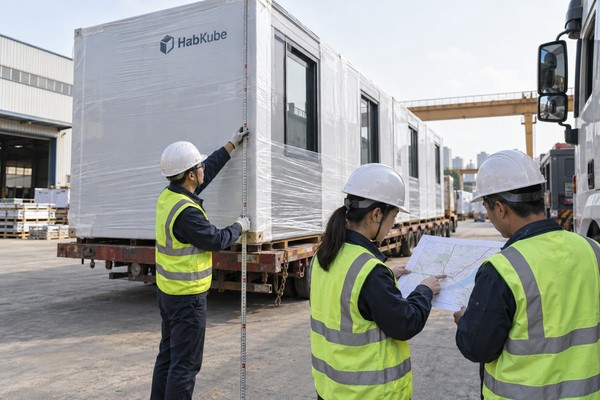
Specify independent evidence without overclaiming it
An implementation check for the buyer
Define what a document proves and what it cannot prove. A product certificate may identify a material, a factory inspection may show the observed assembly, and a shipping document may show that cargo was tendered. None automatically establishes final-site code compliance or full operational performance. Ask who produced each record, what configuration it covers and whether the destination reviewer accepts that evidence. When relying on an external inspector, document sampling basis, access and decision authority before the visit.
Keep exceptions visible through closure. A useful nonconformance record names the affected unit, observed issue, approved correction, reinspection evidence and release decision. Do not hide open items in an email appendix or describe them as “minor” without a criterion. If an unresolved point belongs to local design, keep it outside a supplier’s self-declared pass. The goal is not to block every commercial decision until all uncertainty disappears; it is to put the correct owner and deadline on each uncertainty.
Reconcile the final invoice, packing list, inspection record and receiving report. If a package is damaged, record its identity and condition before contents are dispersed. If a component arrives incomplete, establish whether it was excluded, omitted or lost in transit. That distinction determines the remedy. A repeat buyer can use the first shipment’s exceptions to improve later scopes and inspection points. Treat verified facts as feedback for the next order, not as a reason to invent a success story unsupported by actual project evidence.
Translate the decision into a comparable request for quotation
An implementation check for the buyer
Write an RFQ around the decision in this guide: define the actual shipping envelope. State the application, destination, intended duration, quantity, site information available and the date by which an approved configuration is needed. Attach one controlled drawing register and name the assumptions that are still open. Ask every bidder to mark each requirement as included, optional, excluded or awaiting buyer input. This is more useful than asking for an all-in figure when the material, factory scope, local work and freight basis may differ. A lower bid can then be traced to an actual difference rather than an unexplained total.
Request a line-item scope for product, finishes, factory checks, export packing, freight, site support and commissioning where relevant. Agree the named delivery place, currency, quotation validity, proposed schedule and change method. Where a calculation or certificate is needed, ask who will provide it and whether it applies to the proposed configuration. A product catalog can help narrow options; it should not be used as the contractual design. The buyer should keep a list of decisions whose late change would affect tooling, dimensions, components or local approval. Put a release owner and deadline beside each one.
Compare supplier answers in a matrix with columns for proposal, evidence, exception, owner and next decision. Record whether an answer is a measured fact, a quoted option, a preliminary assumption or an issue reserved for a destination professional. For oversized modular building transport, that distinction matters because commercial language can sound final before the site design is ready. Ask the supplier to explain the basis for any performance or delivery claim. The result should be a decision record the purchasing, technical and installation teams can all understand, not an email chain that only its original authors can interpret.
Plan evidence, interfaces and the final handover
An implementation check for the buyer
Make an evidence list for the risks described above, especially survey terminal, road and site access. Identify what can be checked at material receipt, during factory production, before shipment and after installation. Those stages do not prove the same things. A visible factory mock-up can confirm geometry and workmanship; it cannot certify a complete building or replace the destination authority. If a report is offered, match its specimen, method, configuration and date to the current order. For each unresolved issue, record the specialist or authority that will decide it and the latest practical decision gate.
Divide responsibility at physical interfaces. Factory-supplied parts, foundations, local structural connections, service terminations, import clearance and occupancy approvals may belong to different parties. Put one owner and one acceptance record beside each interface. Sequence delivery so the site can receive, unload and protect the package safely. Match labels and loose hardware to assembly drawings, and provide receiving staff with dimensions, weights and inspection points before the truck or container arrives. Report transport damage promptly against package IDs while the original condition can still be reconstructed.
At handover, retain approved and as-built drawings, product references, relevant inspection records, operating limits, maintenance instructions and written warranty scope. Link them to actual unit IDs. Identify who can make a later change and when local professional review is needed. Ask the operator to review the building after its first period of use, noting access conflicts, leaks, unexpected wear or service difficulty relevant to this topic. Resolve the underlying cause before duplicating the detail in a later order. This is a practical learning loop, not a claim that a hypothetical example is a delivered HabKube project.
A commercial release gate for this order
An implementation check for the buyer
Before authorizing the next contractual milestone, reconcile the agreed scope, approved changes, inspection status and actual unit IDs. If one document uses a different quantity or revision, resolve it before packing or payment. A practical release is based on identified goods and clear exceptions, not merely a verbal report that the order is “almost done.”
At receipt, compare condition and package identity with the dispatch record. Determine whether open items are supplier corrections, transport claims, local installation work or buyer decisions. Keep the outcome visible to finance and project staff. This final reconciliation closes the commercial loop and gives the next purchase a reliable starting point.
Illustrative project exercise
Use this example to test the decision
Illustrative review: a completed module fits an export vessel but is taller than a destination bridge clearance once loaded on its trailer. The buyer needs either a permitted alternative route or a revised shipping configuration, with engineering and packing consequences priced before production release. This scenario is not a HabKube shipment record.
External reference
Use the right reference for the right decision.
This US route-survey reference shows why load dimensions, clearances, turning and permits need coordination; actual permissions and routing belong to the destination carrier and authorities.
Read FHWA oversize-load route-planning manualConclusion
Clarity before commitment.
Lock dimensions only after the complete freight and access chain has been tested. The best transport plan connects module design, route permission and final placement responsibilities.
Related HabKube resources
Ready when you are
Request a transport-envelope review
Email info@HabKube.com with destination, quantity, unloading conditions and any carrier limits. We can provide configuration and packing information for your logistics team.
Send your requirementsCommon questions
Before you request a quote.
When should an oversize route be surveyed?+
Before finalizing dimensions and delivery commitments when the loaded envelope may exceed ordinary limits or the last-mile route is constrained.
Does ocean freight confirmation cover inland delivery?+
No. Port equipment, road permits, bridges, turns and site unloading are separate feasibility checks.
Who obtains road permits?+
Assign this in the contract to the responsible carrier or logistics party and confirm requirements with destination authorities.
Can a module be narrowed after manufacture?+
Sometimes components can be detached, but a new configuration needs structural, enclosure, packing and installation review.