
In this guide
- Define activities, samples and exclusions
- Build the layout from equipment and sample flow
- Translate environmental requirements into service interfaces
- Prepare a utility matrix for every instrument
- Specify finishes for the assessed activities
- Plan specialist commissioning and future change
- Maintain an activity and equipment change register
- Illustrative project review
- Build a quotation that can be evaluated line by line
- Agree factory inspection evidence for this configuration
- Coordinate shipment, installation preparation and local interfaces
- Define handover and the first operating review
- Conclusion
Procurement guidance by the HabKube project team. Examples and AI-generated images are illustrative, not documented customer deliveries or certified test results. Confirm technical and statutory requirements with qualified destination professionals.
Define activities, samples and exclusions
Describe the work rather than assigning a generic room label
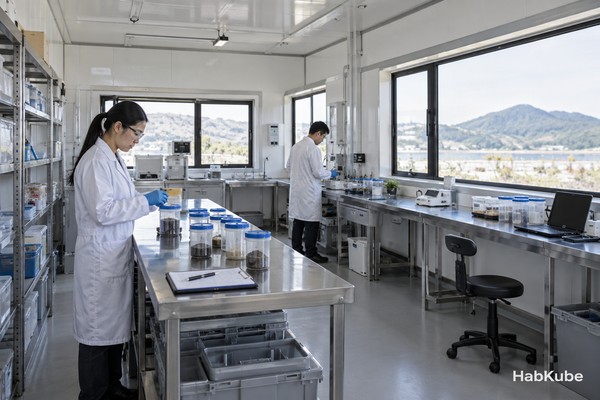
Write a plain-language activity schedule. Identify what arrives, what staff do with it, which equipment is used and what leaves the facility. Distinguish sample reception, preparation, measurement, storage and disposal. State whether the proposed building is only a workspace for nonhazardous testing or needs specialist design for a particular risk.
Laboratory names alone are not adequate specifications. An environmental field-testing room, a materials-testing workspace and a biological laboratory can have very different requirements. Have the operator and qualified specialists assess hazards and necessary controls. Do not infer a biosafety level or containment class from panel materials, a floor plan or the word laboratory on a quotation.
If the assessment is incomplete, identify it as a hold point. A modular building engineering service can coordinate enclosure details once the required functions are defined; it cannot responsibly fill gaps in the operator's risk assessment by selecting standard equipment from a catalogue.
Build the layout from equipment and sample flow
Check working, maintenance and replacement space
Place equipment using manufacturer dimensions and maintenance clearances. Mark opening lids, pull-out trays, operator positions and replacement routes. A compact plan can appear workable until a machine must be serviced or removed. Keep the service envelope visible rather than drawing only each equipment footprint.
Map receipt, storage, preparation, testing, recording and disposal. Where activities must be separated, ask the operator to define the boundary and transfer method. Discuss worktop compatibility, storage conditions, staff amenities and the route for cleaning or maintenance personnel. Avoid promising a clean-to-dirty sequence without reviewing the actual workflow.
Floor loads and vibration need equipment-specific review. State machine weights, support arrangements and any measurement sensitivity. An enclosure suitable for desks is not necessarily suitable for heavy or vibration-sensitive instruments. Coordinate the module, supports and equipment mounting with the responsible engineers before approving the factory drawings.
Translate environmental requirements into service interfaces
Separate comfort systems from process systems
Ask equipment suppliers and the laboratory operator to specify relevant temperature, humidity, ventilation and other environmental conditions. Record which conditions affect staff comfort and which affect test validity or risk control. They may need different systems and different evidence of performance.
A prefab house ventilation system intended for ordinary occupied space should not be represented as specialist extraction or laboratory containment. If dedicated extraction, filtration or pressure control is needed, assign its design, supply and commissioning to qualified parties. Coordinate routes, discharge locations, replacement access and the interface with the building envelope.
Consider interruptions and after-hours operation. Some equipment may require continuous conditions while staff are absent. The operator should define alarm, backup and shutdown requirements from its activities. Put these requirements into the responsibility schedule so the enclosure quotation does not silently exclude a system the laboratory considers essential.
Prepare a utility matrix for every instrument
Use equipment data instead of allowances described as sufficient
List power characteristics, connected load, water needs, drains, data and any other approved services for each instrument. Confirm these values with the equipment supplier. Specify what the factory installs and what the local specialist connects. The term modular house utility connections describes interfaces, not proof that all laboratory equipment can operate from a standard service board.
For prefab house electrical installation, identify local requirements, protection, inspection and licensed-trade responsibilities. Coordinate positions with actual equipment and avoid fixed outlets behind inaccessible machines. For plumbing, establish the permitted drainage arrangement and any treatment or collection requirements with the destination team. Do not assume all laboratory effluent belongs in an ordinary building drain.
Keep interface drawings controlled. If an instrument changes after procurement, review its connections and operating envelope before accepting the substitution. A replacement with similar dimensions can still change load, heat output or drainage requirements enough to affect the installed system.
Specify finishes for the assessed activities
Match each material claim to its purpose and evidence
Choose worktops, floor finishes and enclosure joints based on actual cleaning methods and substances involved. Ask for product-specific compatibility information where relevant. A glossy surface photograph does not demonstrate resistance to the laboratory's cleaning agent or operating process.
Review service penetrations and access panels with the specialist designer. Determine whether any sealing detail is merely a weather detail or part of a required laboratory boundary. These purposes should not be confused. If the modular building fit out includes benches or storage, identify loading, anchoring, finish, installation and maintenance responsibilities for those components.
Inspect a representative assembly before repeating it. Check that staff can reach equipment and that service technicians can access specified components. Keep claims precise: a factory sample can demonstrate arrangement and workmanship, while specialist performance requires the agreed assessment, testing and commissioning evidence for the complete installed system.
Plan specialist commissioning and future change
Release the facility for a defined set of activities
Use the CDC biosafety guidance as a risk-assessment reference where its subject is relevant, while checking the destination requirements and exact activity. It does not certify a portable module. Specialist functions must be established through the operator's assessment and qualified design, not through marketing terminology.
Prepare a commissioning plan that distinguishes enclosure checks from process-system verification. Identify who checks instrument installation, utility performance, environmental conditions and operating procedures. Establish what evidence is necessary before work starts and what happens if the acceptance basis is not achieved.
Laboratory activities can change. Keep a controlled equipment and activity register so a new procedure triggers review of the building and its services. A transportable enclosure may be physically relocatable, but the new location still needs site, utility, specialist and approval review. Treat relocation as a new interface assessment rather than an assumption of unchanged capability.
Maintain an activity and equipment change register
Questions to resolve in the buyer decision record
A laboratory can change after procurement through a new instrument, sample type or procedure. Establish a register linking approved activities to equipment, services and relevant controls. The operator should know which changes require specialist review before work begins.
Use a sample change request to test the process. If an instrument with a different heat output replaces an approved model, who checks environmental conditions and services? If a new procedure introduces a different hazard, who reviews the risk assessment and facility capability? The enclosure supplier should receive controlled interface changes rather than informal requests to add a vent or outlet.
Include records for access and maintenance. A technician unfamiliar with the original installation should be able to identify service routes, shutdown responsibility and the approved replacement method. This is useful for routine reliability without implying any containment or process certification.
When comparing proposals, ask how each accommodates the defined change process. A more flexible fit-out may have value if it preserves reviewed boundaries and access, but flexibility is not permission to operate any future activity. Keep the distinction explicit. An honest laboratory brief defines its approved work and a route for reassessment instead of relying on a generic capability claim.
Project brief
Review the laboratory enclosure interfaces
Send the approved activity brief, equipment dimensions, utility matrix and destination. HabKube can discuss the modular shell and fit-out interfaces with your specialist team.
Get a project quoteIllustrative project review
Use the example to test your own assumptions
Illustrative example, not a HabKube laboratory project: a field-testing operator initially asks for a portable room with benches and air conditioning. A review reveals two instruments with different electrical connections and one device whose measurements are sensitive to vibration.
The operator prepares an equipment register and limits the brief to the defined nonhazardous activities. Its engineer reviews the support arrangement, separates instrument service access from sample handling and identifies the environmental conditions needed for measurements. The supplier then revises bench positions and service allowances against controlled drawings.
This sequence avoids buying a generic fit-out and discovering its limitations after delivery. The enclosure supplier can answer manufacturing questions clearly because the specialist requirements have responsible owners and documented interfaces. The example is a procurement method, not a claim about any particular testing capability.
Build a quotation that can be evaluated line by line
For this project, the purchase brief should include defined laboratory activities, exclusions, risk-assessment responsibility, equipment data, service envelopes, loads, environmental conditions and specialist commissioning interfaces. Put these facts in a numbered schedule and ask the supplier to mark each item as included, optional, excluded or awaiting a buyer decision. This makes a comparison useful even when manufacturers suggest different systems. The buying team can then see whether a lower price reflects a different material, less installation support, fewer fittings or a genuinely more efficient configuration.
Attach one controlled floor plan and a drawing register. Identify the dimensions that are fixed, the interfaces that need coordination and the assumptions that still depend on the site. If an equipment choice changes, record the replacement model and its service requirements before releasing the relevant production detail. A brief that only says “complete unit” gives purchasing, manufacturing and the destination installer too much room to interpret the same order differently.
Budget product supply, export packing, freight, local handling, site work and commissioning as separate responsibilities. Ask how a revision affects the production programme and the price basis. Agree the currency, delivery term, named place, inspection milestone and payment deliverable in the contract. The resulting comparison is a decision record the project can use after the initial commercial discussion is over.
Agree factory inspection evidence for this configuration
The factory review for this guide should focus on bench positions, specified finishes, equipment clearances, service openings, accessible connections and agreement with the controlled equipment schedule. Translate those points into an inspection sheet with the applicable drawing revision, observation method, acceptance reference and person authorized to release the shipment. Ask to see an actual component or representative assembly where an interface matters. A photograph can show arrangement or visible finish; it cannot establish a hidden material property or an entire building performance classification.
Distinguish incoming-material checks, production checks, final inspection and specialist testing. They answer different questions and may occur at different stages. If an inspector needs to see a connection or service route before it is concealed, schedule that hold point before fabrication advances. Any test report should identify its specimen, method, conditions and limitations. Describe demonstrations accurately rather than treating a workshop demonstration as a certified result.
Keep exceptions visible. Record an observed problem, its location, the proposed correction and the evidence needed to close it. Do not approve an unresolved item simply because the shipment date is approaching. A compact evidence pack containing drawing references, relevant measurements, photographs, agreed corrections and the packing list is easier to review than a large folder of unlabeled images. Retain it with the order for receiving and future maintenance.
Coordinate shipment, installation preparation and local interfaces
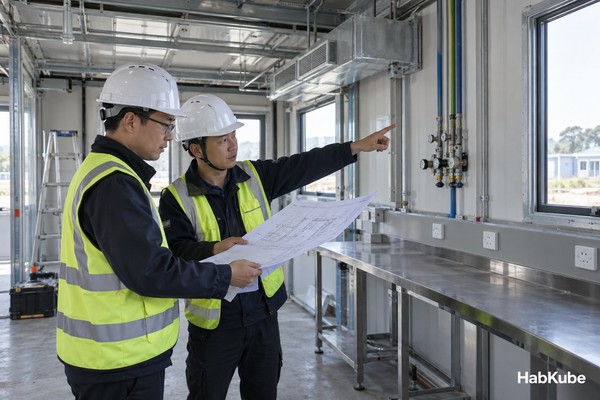
Installation preparation must address approved supports, equipment handling routes, local electrical and plumbing work, process-service coordination and qualified specialist commissioning. Confirm these interfaces before booking the final dispatch slot. The receiving team should know where the delivery vehicle stops, which handling equipment is available, how packages move to protected storage and which local works must be complete. A module can be finished at the factory while the destination site remains unable to receive or use it.
Match package labels to the assembly or placement sequence. Agree how loose hardware, accessories, spare parts and documents will be identified. Share package dimensions and weights with the party planning unloading; that party should select equipment and methods from the approved handling information. Store weather-sensitive items as instructed and protect exposed joints during staged assembly. Report visible transit damage with package identification and dated photographs before discarding relevant packing evidence.
Factory supply, foundations, anchoring, service connections, specialist equipment, inspections and permission to occupy may belong to different parties. Put the responsible owner beside each interface. The local team must confirm requirements for the exact use and jurisdiction, including any licensed trades or professional review. Sequence these decisions around the programme so a finished enclosure is not mistaken for an operational facility.
Define handover and the first operating review
A useful handover for this application includes approved activity limits, equipment register, interface drawings, specialist verification records, maintenance procedures and a process for reviewing future changes. Link each record to the building or equipment identifier so the operator can find it after the installation contractor leaves. Distinguish a supply inspection from operational commissioning. The first confirms the agreed product package; the second confirms that installed systems and local interfaces function together for the intended use.
Name the person responsible for preventive checks, consumables, cleaning and replacement parts. Confirm which components can be serviced locally and which need supplier assistance. Retain finish references, component model details and installation photographs where they will help a future repair. Ask for written warranty terms and the information needed to report a concern, including exclusions and the respective responsibilities for factory components and destination work.
After the initial operating period, compare the planned workflow with what users actually do. Record recurring queues, cleaning difficulties, noise, moisture, access conflicts or maintenance delays relevant to this facility. Resolve the cause before duplicating the configuration in a later order. A planned review makes a pilot or first-phase installation valuable: it produces specific requirements for the next phase without turning an illustrative design into an unsupported performance promise.
External reference
Use the right reference for the right decision.
CDC describes risk assessment as central to laboratory planning. Laboratory capability must be established for the actual work, equipment and operating protocols.
Read CDC Biosafety in Microbiological and Biomedical LaboratoriesConclusion
Clarity before commitment.
Specify the laboratory activity first and the portable building second. Equipment data, risk assessment and specialist responsibilities turn a broad request into a usable purchasing scope. A controlled enclosure and interface package is valuable precisely because it does not imply capabilities that have not been established.
Related HabKube resources
Ready when you are
Request a scoped modular workspace proposal
Describe the work, exclusions, service requirements and commissioning responsibilities. Email info@HabKube.com to begin an enclosure-focused review.
Send your requirementsCommon questions
Before you request a quote.
Does a portable laboratory have an automatic containment classification?+
No. A classification requires assessment of the intended activities and the appropriate design and verification. A modular enclosure or ordinary ventilation system does not establish containment capability.
What should be fixed before enclosure manufacture?+
The activity scope, equipment schedule, working and service clearances, relevant loads, environmental requirements, service interfaces and responsibilities should be agreed before affected details are released.
Can laboratory equipment be installed after delivery?+
It can be planned that way, but its space, loads and utilities still need early coordination. Late installation is not a reason to omit equipment data from the building brief.
Can the laboratory move without another review?+
A new location changes supports, utilities, environmental conditions and approvals. Review those interfaces and any specialist requirements before restarting operations.