
In this guide
- Define a common functional brief
- Compare schedules through dependencies, not slogans
- Price logistics and interfaces honestly
- Include operating and future-change consequences
- Run a schedule and cost sensitivity exercise
- Compare options under the same constraints
- Create a defensible decision record
- Translate the decision into a comparable request for quotation
- Plan evidence, interfaces and the final handover
- A decision gate before choosing a delivery route
- Illustrative project exercise
- Conclusion
Procurement guidance by the HabKube project team. Examples and AI-generated images are illustrative, not documented customer deliveries or certified test results. Confirm technical and statutory requirements with qualified destination professionals.
Define a common functional brief
A comparison to document
Start with the rooms, usable area, occupancy, climate, expected life, fire and accessibility requirements, finishes and utility loads. Ask both a prefab supplier and a conventional contractor to respond to the same performance and scope basis. A modular quote for an empty shell cannot be compared with a site-built price that includes foundations and services. Nor does a fully finished prefab unit automatically include site landscaping or authority fees. Normalize the comparison line by line.
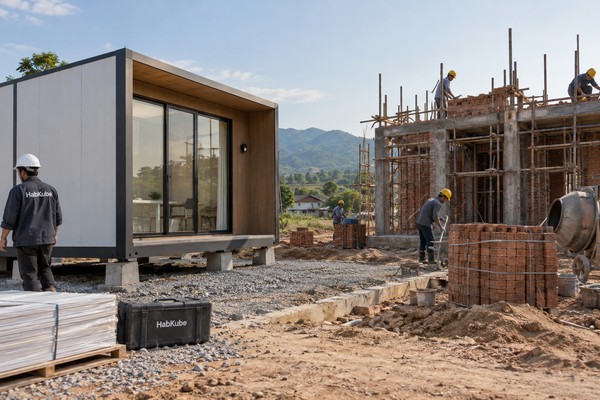
Keep the decision connected to the project’s objective. A remote camp might value a predictable production package and repeatable units; a complex irregular urban infill site might favor more on-site adaptation. Availability of trades, access width, crane setup and local material supply can change the answer. Ask each bidder to show assumptions and exclusions, not a single headline unit cost. A credible comparison can conclude that the mixed or conventional option is preferable for a particular project.
Compare schedules through dependencies, not slogans
A comparison to document
Draw a common schedule from concept through design approval, procurement, site work, fabrication, delivery, installation, inspections and occupancy. Off-site construction may allow some activities to run in parallel, but only if decisions and permits are available early enough. A delayed foundation or utility connection can erase apparent factory speed. Conversely, a conventional project may be constrained by weather or trade sequencing. Use actual supplier and local-contractor programmes rather than generic “half the time” claims.
Identify design-freeze gates. Prefabrication rewards early decisions on openings, services and module dimensions; late changes can be expensive. Site construction may absorb certain field adjustments, but they can also trigger rework or delays. Compare how each method handles uncertainty that remains in your project. If the site survey is incomplete, either route can be risky; make the missing decision explicit rather than burying it in a contingency percentage.
Price logistics and interfaces honestly
A comparison to document
For the modular option, add export packing, freight, import handling, unloading, foundations, cranage, module joins, utility connections and local inspections where applicable. For conventional construction, include site labor, temporary works, weather protection, waste handling and on-site quality oversight. Compare the same taxes, insurance assumptions and delivery point. A per-square-meter figure is only a screening metric until these scope differences are closed.
Assess interface ownership. Who checks that the foundation matches the module anchor plan? Who closes weather and fire joints after installation? Who commissions the utility service? Conventional contractors have interfaces too, but their responsibility may be packaged differently. Request a responsibility matrix for each delivery route. The buyer should be able to identify one person who accepts each boundary and evidence needed for handover.
Include operating and future-change consequences
A comparison to document
Compare inspection access, spare parts, maintenance skills, future extension and possible relocation. A factory-built building can be repeatable and still difficult to repair if its parts are undocumented. A site-built facility can be familiar locally and still suffer from inconsistent workmanship. Judge the proposed detail and service model, not the construction label. Ask how each option handles a damaged wall, added service or changed room use.
For multi-phase projects, a pilot or representative unit may reduce uncertainty. Review measured outcomes that matter to the owner: actual installed scope, punch-list closure, time to obtain occupancy approval, maintenance access and any defects. Do not claim that every prefab project is cheaper or greener; material transport, process and site context matter. A documented decision can choose prefab for one building type and traditional construction for another within the same development.
Run a schedule and cost sensitivity exercise
A project-level decision exercise
Build two schedules with identical opening date and fit-out level. For the prefab route, show design freeze, factory procurement, fabrication, transport, site works, installation and local approval. For the conventional route, show design release, procurement, site structure, enclosure, fit-out and inspection. Identify the critical path in each, not just total activity days. If foundation approval is delayed, which tasks can still proceed? If a late room change occurs, which method bears more rework? The answer may change as project certainty improves.
Prepare two cost cases: expected and constrained. The constrained case might include tight site access, unusual ground conditions or limited destination labor. Use actual quotations where possible and flag estimates. Compare complete delivered scope, not headline price per square meter. A modular option may shift labor into the factory but add heavy transport and cranes; a site-built option may avoid freight but require prolonged temporary works. Include commissioning and owner maintenance. Reject claims of universal savings unless the specific project evidence supports them.
Ask each bidder to state what it needs from the owner by a fixed date. The resulting input list often decides feasibility more clearly than a brochure. If a prefabricated solution requires dimensions that cannot be frozen yet, a hybrid approach may reduce risk. If ten rooms are identical and site access is straightforward, repeatable production may be attractive. Preserve this decision record and revisit it after the first phase using actual schedule and cost data, not retrospective marketing claims.
Compare options under the same constraints
An implementation check for the buyer
Start with the buyer’s non-negotiables: legal use, site, expected duration, climate, occupancy, room functions, performance and budget basis. Every alternative should answer the same brief. Otherwise a cheap shell can appear to defeat a fully installed option simply because its missing work is invisible. Ask bidders to separate supply, local design, approvals, freight, foundations, services, installation and handover. Note any differences that cannot be normalized without a further professional review.
Use scenario checks rather than one “best” score. What if access narrows, an opening moves, occupancy changes or the building must be reused? Some options tolerate a late design change better; others depend on early factory release. Identify which uncertainty is material to this project. A comparison table should show evidence source and confidence beside cost and time. If the destination classification or permit route is unsettled, do not present a forecast as a guarantee.
Keep supplier claims in proportion to their evidence. Factory work can improve repeatability in some conditions but does not automatically reduce cost or guarantee quality. A familiar local method can simplify some repairs but can also add site variability. The buyer should inspect drawings, processes and responsibility boundaries for the actual offers. Avoid turning the article title into a universal recommendation. The right conclusion may be a hybrid solution or a decision to wait until the site facts are known.
Project brief
Compare both routes on one scope
Send HabKube your room programme, site constraints and project schedule so a prefab configuration can be priced against a clear baseline.
Get a project quote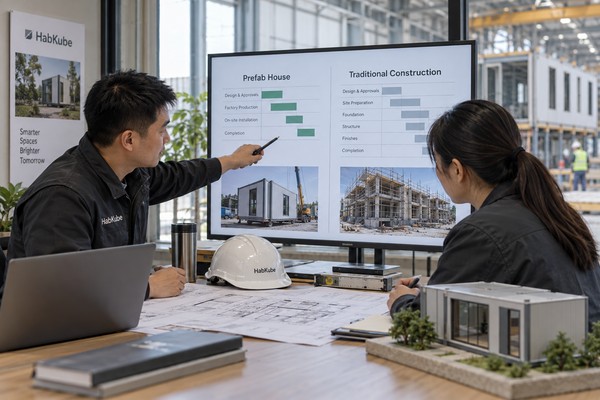
Create a defensible decision record
An implementation check for the buyer
For each option, write down the assumed product, approval path, key dimensions, delivery method, site scope and operating responsibility. Assign a named owner to unresolved points and a deadline before they affect fabrication or contract commitment. Include the cost of verification, not only the cost of supply. A quotation that needs local engineering, brokerage or a specialist inspection is still viable, but those services belong in the project plan.
Review the decision with people who will install and operate the building. Purchasing may focus on unit price while facilities staff notice inaccessible parts or an awkward route. A local designer may identify a classification conflict that an exporter cannot resolve. Record objections and their resolution; an unresolved issue should not disappear when a preferred option is chosen. This is especially important in cross-border procurement, where product names and code pathways may differ.
Once selected, preserve the comparison as the basis for change control. If the owner later alters use, quantity, location or schedule, revisit the assumption that drove the choice. Compare the final delivered scope with the decision record after the first phase. This is not about proving the initial team right; it is a way to make later purchases more informed. Publish only real, verifiable outcomes as case evidence. Hypothetical exercises in a buyer guide should remain clearly labeled.
Translate the decision into a comparable request for quotation
An implementation check for the buyer
Write an RFQ around the decision in this guide: define a common functional brief. State the application, destination, intended duration, quantity, site information available and the date by which an approved configuration is needed. Attach one controlled drawing register and name the assumptions that are still open. Ask every bidder to mark each requirement as included, optional, excluded or awaiting buyer input. This is more useful than asking for an all-in figure when the material, factory scope, local work and freight basis may differ. A lower bid can then be traced to an actual difference rather than an unexplained total.
Request a line-item scope for product, finishes, factory checks, export packing, freight, site support and commissioning where relevant. Agree the named delivery place, currency, quotation validity, proposed schedule and change method. Where a calculation or certificate is needed, ask who will provide it and whether it applies to the proposed configuration. A product catalog can help narrow options; it should not be used as the contractual design. The buyer should keep a list of decisions whose late change would affect tooling, dimensions, components or local approval. Put a release owner and deadline beside each one.
Compare supplier answers in a matrix with columns for proposal, evidence, exception, owner and next decision. Record whether an answer is a measured fact, a quoted option, a preliminary assumption or an issue reserved for a destination professional. For prefab house vs traditional construction, that distinction matters because commercial language can sound final before the site design is ready. Ask the supplier to explain the basis for any performance or delivery claim. The result should be a decision record the purchasing, technical and installation teams can all understand, not an email chain that only its original authors can interpret.
Plan evidence, interfaces and the final handover
An implementation check for the buyer
Make an evidence list for the risks described above, especially compare schedules through dependencies, not slogans. Identify what can be checked at material receipt, during factory production, before shipment and after installation. Those stages do not prove the same things. A visible factory mock-up can confirm geometry and workmanship; it cannot certify a complete building or replace the destination authority. If a report is offered, match its specimen, method, configuration and date to the current order. For each unresolved issue, record the specialist or authority that will decide it and the latest practical decision gate.
Divide responsibility at physical interfaces. Factory-supplied parts, foundations, local structural connections, service terminations, import clearance and occupancy approvals may belong to different parties. Put one owner and one acceptance record beside each interface. Sequence delivery so the site can receive, unload and protect the package safely. Match labels and loose hardware to assembly drawings, and provide receiving staff with dimensions, weights and inspection points before the truck or container arrives. Report transport damage promptly against package IDs while the original condition can still be reconstructed.
At handover, retain approved and as-built drawings, product references, relevant inspection records, operating limits, maintenance instructions and written warranty scope. Link them to actual unit IDs. Identify who can make a later change and when local professional review is needed. Ask the operator to review the building after its first period of use, noting access conflicts, leaks, unexpected wear or service difficulty relevant to this topic. Resolve the underlying cause before duplicating the detail in a later order. This is a practical learning loop, not a claim that a hypothetical example is a delivered HabKube project.
A decision gate before choosing a delivery route
An implementation check for the buyer
Summarize the preferred option in one page: intended use, destination approval path, installed scope, expected programme, full cost basis and the most important assumption. Ask technical, commercial and operating stakeholders to sign off on what remains uncertain. If an approval path is unresolved, a conditional selection is more honest than a final commitment based on labels.
After the first phase, compare actual records with the assumption that drove selection. Did the critical date, transport constraint or local approval behave as forecast? Record the answer and use it to revise future decisions. A buyer guide can supply questions and frameworks; only real project records can establish whether a chosen route delivered the expected result.
Illustrative project exercise
Use this example to test the decision
Illustrative comparison: a remote project needs ten repeatable offices and one highly customized workshop. The buyer could evaluate prefabrication for the offices and conventional or hybrid construction for the workshop. The decision should use actual route, trade and approval data rather than one average percentage saving. This is a hypothetical procurement exercise.
External reference
Use the right reference for the right decision.
ICC describes design, fabrication, inspection and final-site compliance as connected work. The adopted edition and approval route must be confirmed by the destination authority.
Read ICC/MBI off-site construction standards overviewConclusion
Clarity before commitment.
Choose the method that fits the specific project constraints and complete scope. Compare schedules, costs, approvals and maintenance on the same basis, and keep uncertainties visible.
Related HabKube resources
Ready when you are
Request a project-level prefab assessment
Email info@HabKube.com with use, quantity, destination and site data. We can discuss modular scope and exclusions for a fair delivery-method comparison.
Send your requirementsCommon questions
Before you request a quote.
Are prefab houses always cheaper?+
No. Compare full project scope, freight, site work, approvals and lifecycle obligations. Initial unit price alone is not enough.
Are prefab houses always faster?+
No. Parallel work can help, but permits, design freeze, foundations and logistics may govern the schedule.
Can a project combine both methods?+
Yes, subject to compatible design and clear interface responsibility. A hybrid approach can suit differing building functions.
Which option has better quality?+
Quality depends on design, materials, process controls, competent installation and inspection, not the method label alone.