
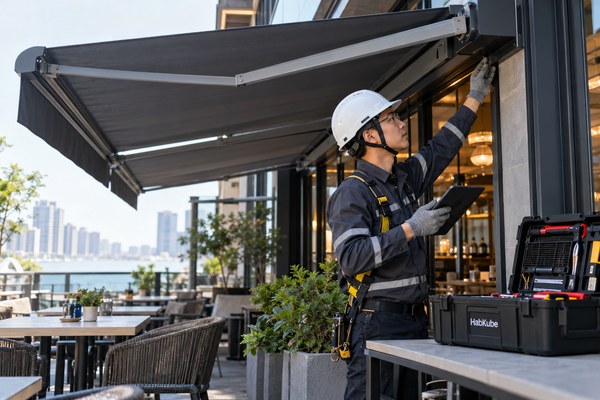
In this guide
- The direct answer: how to plan retractable awning motor
- Define the use case with measurable operating facts
- Map the complete system, not one attractive component
- Specify the drive as an maintainable electromechanical assembly
- Survey the site before releasing fabrication
- Assign design, compliance and approval responsibilities
- Write an RFQ that produces comparable technical offers
- Plan operation, monitoring and shutdown before handover
- Request evidence that answers a specific buyer question
- Agree factory inspection and shipment release points
- Connect packing, delivery and installation to the technical plan
- Compare lifecycle cost, maintenance and change risk
- Run a buyer decision exercise before placing the order
- Conclusion
Procurement guidance by the HabKube project team. Examples and AI-generated images are illustrative, not documented customer deliveries or certified test results. Confirm technical and statutory requirements with qualified destination professionals.
The direct answer: how to plan retractable awning motor
Start with the operating outcome, then select the product configuration
Professional buyers should begin retractable awning motor with the real operation, destination and people who will use the space. For motorized window, terrace and storefront awnings, the central decision is to select and document a complete drive and control package that can be commissioned and serviced locally. That answer should be written before a supplier recommends dimensions or components. It gives procurement, engineering, installation and operations one shared test for every option, and it prevents the catalogue model from becoming the specification by default.
The main risk is that an inaccessible motor, unverified voltage, incorrect limits or misunderstood override can damage the fabric and arms or leave the awning exposed during a power failure. Treat that risk as a design input, not a problem to solve after delivery. Record what is known, what is still provisional and which party has authority to close each open point. A useful early brief is deliberately honest: it can state the intended use and target outcome while reserving structural, electrical, fire, access or workplace decisions for qualified destination professionals.
Define the use case with measurable operating facts
Convert broad words such as “heavy duty” or “commercial grade” into observable requirements
For this project, collect awning size and geometry, expected cycles, voltage and frequency, control location, sensor strategy, group operation, emergency access, cable route and local electrical requirements. Give the supplier a marked plan, photographs and a short written narrative that explains the busiest operating condition. A nominal width, projection or floor area cannot show who moves where, what equipment is present, when weather matters or which route must remain clear. The brief should describe normal use, peak use and the condition that triggers a shutdown or evacuation.
Separate requirements from preferences. A required clear route, opening, service zone or operating limitation belongs in the controlled specification. A preferred color or accessory can remain an option until its effect on price and schedule is understood. Ask every bidder to list exclusions and assumptions beside the matching requirement. This makes a technical discussion faster because the team can see which facts are settled and which questions still need evidence.
Map the complete system, not one attractive component
Review the aluminum shade system, its supports, accessories and surrounding work as one installed arrangement
A reliable solution depends on interfaces. Draw the primary frame, moving or tensioned parts, openings, drainage, electrical items, finishes and site supports on the same set of documents. Add any furniture, vehicles, production equipment or building features that can touch the product. If the project changes one interface, check the others again; a different opening or accessory may affect the structural load path, water path, clearances, controls, packing and installation sequence.
Require a component schedule that names each factory-supplied item and distinguishes local work. Avoid details that say only “by others” without identifying the party, design basis or handover point. The buyer should be able to trace a requirement from the operating plan to a drawing, from the drawing to a component, and from the component to an inspection or site check. That trace is more useful than a generic claim that the product is complete.
Specify the drive as an maintainable electromechanical assembly
Motor, arms, fabric and controls must be compatible
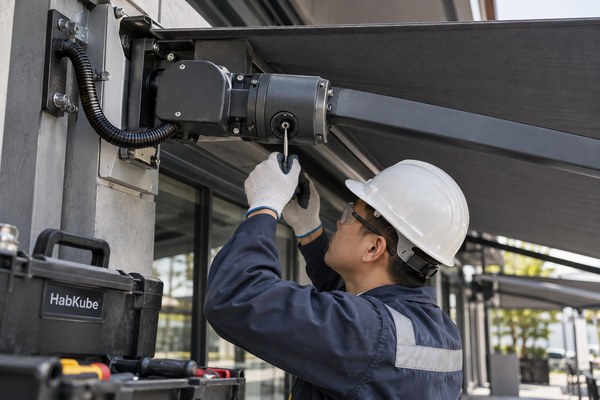
Ask the supplier to identify how torque, tube, projection, arm force, fabric size and expected cycle are matched. A larger motor is not automatically safer; incorrect limits or excessive force can damage stops and fabric. Confirm supply voltage and frequency for the destination, controller compatibility and whether group controls require additional relays or commissioning. Local electrical protection and isolation remain with the qualified installer.
Demonstrate manual override without placing a user beneath moving arms or requiring inaccessible tools. The handover should explain whether override is intended only for power loss and which direction is safe. Mark isolation, retain the correct crank or key and test restoration to normal operation. Do not use manual force to overcome ice, an obstruction or mechanical damage. Those conditions require inspection first.
Survey the site before releasing fabrication
A product configuration is only as useful as the site information behind it
Review isolation position, concealed cable routes, water paths, motor access, facade penetrations, operator visibility and clearance from doors, signs and lighting. Use measured dimensions and levels where interfaces are critical. Photographs should include scale and direction, not just a close view of the preferred installation area. When underground or concealed conditions matter, obtain records and verify them through the appropriate site process. The factory can discuss product needs, but it cannot safely infer ground capacity, facade structure, buried services or local approval from an image.
Build a last-mile installation sequence from delivery vehicle to final position. Identify unloading, staging, lifting or access equipment, protected storage, work zones and weather constraints. Confirm that temporary works and exclusion areas do not block required circulation. If the site changes after approval, issue an updated survey and controlled revision. Discovering a conflict on paper is normally less disruptive than changing brackets, foundations, membranes or controls during installation.
Assign design, compliance and approval responsibilities
Supplier documentation supports destination review; it does not replace it
List the destination authority, adopted rules and professional disciplines that may need to review the project. Depending on use, that can include structure, fire and life safety, accessibility, electrical work, mechanical services, workplace safety, facade or landlord control and civil drainage. Ask a qualified local party to confirm applicability. Do not present a foreign standard, isolated test or supplier drawing as universal permission to install or operate.
OSHA guidance on cord-connected electrical equipment is a useful external reference for this topic, but its scope and jurisdiction must remain visible. This US workplace reference illustrates inspection and protection principles. A licensed destination electrician must determine the rules and final design that apply locally. Put every requested document into an evidence matrix with issuer, product or system covered, date, test or requirement, limitation and destination reviewer. A transparent gap is safer and more trustworthy than a folder of unrelated certificates.
Write an RFQ that produces comparable technical offers
Give each supplier the same baseline and require a line-by-line response
The request for quotation should include application, destination, quantity, expected schedule, drawings, site information, performance questions and the evidence expected before shipment. For retractable awning motor, state the decision to be made in plain language. Ask the supplier to propose a configuration and explain the assumptions rather than forcing a product name that may not fit the site. Keep one revision number across the scope, plan and schedules.
Require separate lines for the primary product, accessories, controls or services, export packing, freight-related work and destination installation support. Mark every line included, optional, excluded or pending information. Price differences then become explainable. One proposal may include a control, gutter, opening, floor interface or protective pack that another omits. The buyer can evaluate those differences instead of mistaking an incomplete quotation for a more competitive system.
Project brief
Review the retractable awning motor brief
Send HabKube the application, dimensions, site context and destination. We can help identify the factory-product questions and evidence to place in the RFQ.
Get a project quotePlan operation, monitoring and shutdown before handover
The owner needs clear actions for ordinary use and adverse conditions
Document opening and closing sequence, manual-override training, wind and rain response, obstruction awareness, power-loss procedure, cleaning and seasonal shutdown. Name the trained person who can change the operating state, stop an activity or close an area. Set the decision route before a live event or busy work shift. An automatic control, warning, sensor or rated component can support that plan, but it cannot observe every obstruction, maintenance issue, local gust, user behavior or power failure. Human responsibility and communication remain part of the system.
Create a simple pre-use check, periodic observation and post-event check. The list should refer to visible conditions and manufacturer instructions, not invent new performance limits. If a product is moved, reconfigured or used for a different activity, reassess the site and operating plan. Keep emergency and maintenance instructions accessible to the destination team, and translate critical actions where the workforce cannot reliably use the supplier's original language.
Request evidence that answers a specific buyer question
Use an evidence matrix instead of collecting unlabelled files
For this topic, useful evidence can include motor model and torque basis, compatibility statement, wiring schematic, enclosure rating, limit-setting instructions, override method, parts list and warranty terms. Every file should answer a defined question: what was designed, what was supplied, what was observed and what remains for local work. Check the model, dimensions, materials, revision and issuing organization. A report for a similar component may inform discussion, but the buyer should not describe it as proof for the ordered configuration unless the documented scope supports that conclusion.
Agree when the evidence is reviewed. Some records are needed before design release, some before material purchase, some during assembly and some at site acceptance. If an inspector will witness a check, provide the approved drawings and acceptance criteria in advance. Record exceptions with their affected units, proposed disposition, approval and reinspection. This creates a usable chain of decisions without pretending that factory documentation can certify completed destination work.
Agree factory inspection and shipment release points
Inspect the characteristics that may become hidden, mixed or difficult to correct after export
The factory inspection plan should cover motor and controller identity, cable protection, brackets, arm movement, end limits, override access, remote functions and labeling before handover. Start with incoming identity and first-off assembly where that is practical, then use risk-based sampling for repeated components. Photographs need labels and context; dimensional records need the point measured and criterion used. A visual review cannot replace a formal test, and a passed component check cannot approve the final installation on an unknown site.
Before packing, reconcile the bill of materials, drawings, loose accessories, spares and unit or package labels. Protect finished and moving surfaces against the actual shipping method. Ask the receiving team whether it can identify the first required pack without opening unrelated crates. A shipment inspection is valuable when it links approved scope, visible condition and packing; it is not valuable when it produces hundreds of unindexed images with no decision trail.
Connect packing, delivery and installation to the technical plan
The installation team should receive information in the order it will use it
Prepare a packing index by installation sequence. Include package IDs, contents, dimensions and handling notes where relevant. Separate sensitive controls, fabric or finish surfaces, small hardware and site-use documents. Confirm the delivery term and named place in the contract, then align container loading, destination handling and risk transfer with that written term. Never assume a trade term defines technical installation or approval responsibility.
At receiving, document package and component condition before assembly obscures transport damage. Verify the current drawing revision, site readiness, support points, clearances and temporary work controls. Complete local connections and tests through qualified parties. The site acceptance record should distinguish factory supply, transit condition, installer work and owner operation. That separation helps the team diagnose issues rather than assigning every symptom to the product or every defect to the site.
Compare lifecycle cost, maintenance and change risk
A defensible purchase decision looks beyond the initial equipment price
Build a lifecycle comparison that covers design and approval, site work, product supply, freight, installation, controls, inspections, cleaning, consumables, predictable component replacement, access equipment and downtime. Use ranges where information is uncertain and state the planning period. Do not invent a payback or service life. The useful question is which assumptions move the decision and how the owner will monitor them after handover.
Ask how critical parts are identified and obtained. Keep motor, sensor, membrane, fabric, seal, fastener, coating and hardware references where relevant. Define inspection after unusual weather, impact, relocation or repair. If the owner cannot access or identify a replaceable item, the installed system may be difficult to maintain even when the factory workmanship is satisfactory. Future flexibility should be evaluated as a documented option, not a marketing promise.
Run a buyer decision exercise before placing the order
Use a realistic change to test whether the specification remains coherent
A restaurant specifies remote control but does not provide access to the concealed motor after the ceiling is closed. The design should add a service route and verify isolation and manual recovery before fabrication. This is an illustrative decision exercise, not a documented HabKube customer project, measured performance result or certification. Its purpose is to show how one change can affect configuration, site work, evidence, operation and commercial scope at the same time.
Close the exercise with a one-page decision record. State the proposed configuration, open assumptions, responsible reviewers, required evidence, factory release gate, site readiness gate and owner operating action. If one of those items has no owner, the procurement is not ready for an unconditional release. HabKube can help clarify the factory product and packing scope, while destination professionals remain responsible for local design, permits, installation and operational approval.
External reference
Use the right reference for the right decision.
This US workplace reference illustrates inspection and protection principles. A licensed destination electrician must determine the rules and final design that apply locally.
Read OSHA guidance on cord-connected electrical equipmentConclusion
Clarity before commitment.
For retractable awning motor, the strongest buying decision connects the operating need, site facts, product interfaces, destination responsibilities and inspection evidence. Start with awning size and geometry, expected cycles, voltage and frequency, control location, sensor strategy, group operation, emergency access, cable route and local electrical requirements, then ask each supplier to answer the same controlled brief. Confirm local design and approval with qualified destination parties, and keep factory supply, shipping, installation and owner operation clearly separated. Send HabKube the application, dimensions, quantity, destination and available drawings to begin a practical configuration discussion.
Related HabKube resources
Ready when you are
Send your project requirements to HabKube
Email info@HabKube.com with the application, approximate dimensions, quantity, destination and any drawings or photographs. Ask for a product, inspection and packing discussion for motorized window, terrace and storefront awnings.
Send your requirementsCommon questions
Before you request a quote.
What information should I send for retractable awning motor?+
Send the intended application, destination, approximate dimensions, quantity, site photographs or drawings, operating conditions, desired schedule and the open technical questions. Include awning size and geometry, expected cycles, voltage and frequency, control location, sensor strategy, group operation, emergency access, cable route and local electrical requirements.
Can the supplier guarantee local approval?+
No supplier should promise universal approval without the destination, use, adopted rules and authority review. Ask HabKube for product information and involve qualified local professionals for engineering, permits and final acceptance.
What should be checked before shipment?+
Agree a project-specific inspection plan covering motor and controller identity, cable protection, brackets, arm movement, end limits, override access, remote functions and labeling before handover. Link every record to the current drawing, component or package identity and document any exception and reinspection.
How should buyers compare quotations?+
Issue the same controlled RFQ to each bidder. Compare configuration, materials, evidence, accessories, packing, trade term, installation exclusions, lead-time assumptions, maintenance and lifecycle responsibilities line by line.