
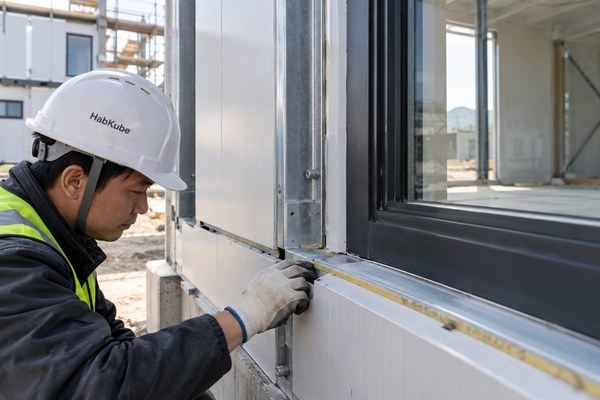
In this guide
- Locate bridges before selecting a product
- Assess comfort and moisture together
- Request evidence that matches the proposed junction
- Preserve the detail through transport and reuse
- Compare two junctions instead of two panel labels
- Translate performance language into an approved assembly
- Rehearse transport, installation and first use before releasing drawings
- Map the interfaces that a product sample cannot show
- Set a proportionate verification and maintenance plan
- A final envelope decision review
- A concise RFQ brief the supplier can actually answer
- A buyer-ready decision record for this project
- Illustrative buyer decision exercise
- Conclusion
Procurement guidance by the HabKube project team. Examples and AI-generated images are illustrative, not documented customer deliveries or certified test results. Confirm technical and statutory requirements with qualified destination professionals.
Locate bridges before selecting a product
Project-specific decisions
Review wall, roof and floor sections with the primary steel and secondary framing highlighted. Mark where metal connects outside and inside conditions. Then add window and door frames, external brackets, roof edges and intermodule joints. A supplier might demonstrate a high-insulation panel while the main frame passes through it. The buyer needs to know which path governs the actual design. Ask the destination energy consultant whether point or linear bridge calculations matter for the compliance path.
Not every metal part should be interrupted without structural review. A thermal-break pad or isolated fixing changes a connection and must still carry the design forces. Ask for the material, thickness, compressive properties, fastening and durability basis appropriate to the assembly. A photograph of a plastic-looking strip is not a structural or thermal analysis. If the supplier proposes a different frame geometry to reduce bridging, check the effect on panel span, openings and manufacturing sequence.
Assess comfort and moisture together
Project-specific decisions
A cold surface near a corner can cause discomfort and, under some conditions, condensation. But comfort depends on room air movement, glazing, heating or cooling strategy and occupant position as well as the frame detail. Request a realistic interior layout and identify sensitive zones such as beds, workstations and wet rooms. The local designer should select the assessment method and boundary conditions. Do not promise a condensation-free building from one connection sample.
Check insulation continuity where the roof meets the wall and where a module rests on supports. A raised floor with an exposed perimeter may behave differently from a slab-supported unit. At window jambs, the frame position in the wall and the perimeter seal affect both heat and air leakage. Specify which party completes insulation and air sealing after modules join. If a gap remains for site connection, show exactly when it is closed and how the work will be inspected.
Request evidence that matches the proposed junction
Project-specific decisions
Ask for a dimensioned detail, material properties and calculation or test basis relevant to the exact geometry. A center-of-panel thermal value does not include frame effects; a window U-factor does not cover an uninsulated steel reveal. Check units and rating methods before comparing suppliers. When calculations use assumed fastener spacing or insulation continuity, verify those assumptions in the factory. If reports are generic, state what they do and do not prove.
A representative mock-up can show whether an isolation piece fits reliably during assembly and whether adjacent seals remain accessible. Inspect after fastening but before the detail is covered. Record the material reference, orientation, connection and any substitution. If a thermal-break component is omitted in a production batch, a later photo of the finished wall may not reveal it. Plan the hold point early and link the record to affected unit IDs.
Preserve the detail through transport and reuse
Project-specific decisions
A factory-installed insulated junction may be compressed, exposed or interrupted when units are lifted and joined. Ask how temporary transport restraints are removed and what replaces them. If the final joint is built on site, give the crew an assembly sequence with required materials and inspection access. Protect the break from water storage and incompatible sealants. Later maintenance should not bridge it with an improvised metal bracket or fastener.
Compare options on full assembly cost and operating consequences. A detailed bridge treatment may add labor but reduce a recurring cold spot; another solution may change frame layout. Without project-specific modeling, avoid assigning a fabricated energy-saving percentage. Keep drawings and parts with the handover file so a future relocation or replacement does not erase the reason for the original detail.
Compare two junctions instead of two panel labels
A specific review to perform before order release
Request a detail of one uninterrupted wall field and one steel-frame opening corner. Ask for the thermal path and the physical connection that carries structural forces. If the proposal adds an isolation piece, review its material properties, fixing sequence and protection during assembly. The comparison should state what is included in any reported U-value or modeled result. A panel-only value and a full-assembly value are not directly comparable. The local energy specialist can decide whether the junction warrants a specific calculation.
Then ask the factory to build or expose a representative corner during first-article inspection. Confirm that the break is present in the correct position, that adjacent air and water seals remain continuous, and that installers can reach the module join after delivery. A photograph of the outer cladding is not sufficient evidence because it hides the critical path. Keep the detail and material identity in the handover, so a later repair does not install a conductive substitute across the original thermal separation.
Translate performance language into an approved assembly
Practical review for the buyer
A specification is useful only when it names the actual building configuration. Ask the supplier to identify the roof, wall, opening, floor and frame interfaces affected by the proposed feature. A catalogue value may describe a component in isolation; a completed modular unit includes fixings, gaps, penetrations, drainage and field-installed connections. Put the approved drawing revision beside every performance claim. If an option changes during procurement, ask which evidence and details must be reviewed again. This is especially important when a nominally similar product has a different core, facing, frame or installation method.
Request evidence in layers: product identity, relevant test or calculation, representative assembly detail, factory inspection point and destination-side verification. Each layer answers a different question. A report from an unrelated specimen is a discussion starter, not automatic proof for the ordered configuration. Where a rating or legal requirement is involved, have the qualified destination professional determine applicability. The export supplier can provide drawings and records, but should not pretend to grant local approval. Put assumptions and open items in a register that travels with the project rather than burying them in quotation notes.
Rehearse transport, installation and first use before releasing drawings
Practical review for the buyer
Trace the assembly from a dry factory bay to a packaged load, a destination yard and its final operating position. Ask what must be protected in transit, what arrives loose, which closures are completed on site and who is permitted to make a change. A detail that works when installed in the factory may be exposed during shipping or impossible to inspect after the module is placed close to another building. Require handling and installation instructions for fragile edges, seals and components. Clarify the receiving check before protective wrapping is discarded.
At first use, operators will open doors, adjust equipment, clean surfaces and maintain drains or seals. Check access with furniture and local utility connections in place. Give the owner an inspection route and replacement reference for components likely to need attention. A single photographic handover does not establish durability; the project needs identified parts, limits and a way to record defects. If the building may be relocated, include the disconnection and reinspection steps in the original design review. Reuse does not erase the need for a fresh site and code check.
Project brief
Find the bypass paths in your envelope
Share wall, floor and roof sections with HabKube to identify junctions needing technical review.
Get a project quote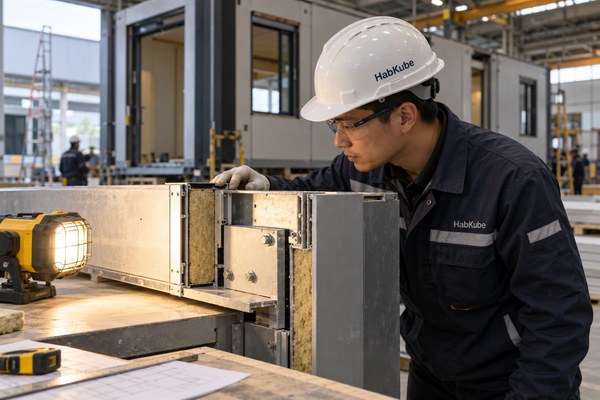
Map the interfaces that a product sample cannot show
Practical review for the buyer
Draw one interface map covering the component, neighboring panels, primary frame, service penetrations, site supports and any occupant-facing finish. For each boundary, identify the weather line, air line, thermal path, restraint and maintenance access. An isolated sample may prove dimensions and workmanship but cannot show how a different wall thickness or site closure behaves. Ask for a representative corner or opening mock-up if the detail is critical. State which interfaces leave the factory complete and which are closed by the installation crew. Missing responsibility at a small interface can produce a disproportionately large repair.
Keep details at a usable scale and label the actual materials and fixing sequence. A line marked “seal as required” is not a construction instruction. Ask whether a later technician can inspect or renew the joint without destroying adjacent finish. Consider how a transport strap, temporary cover or lifting operation could damage an exposed edge. Review the first installed unit before ordering a large repeat batch when the project permits. Findings should change the controlled drawing, not live only in a meeting note.
Set a proportionate verification and maintenance plan
Practical review for the buyer
Choose checks that correspond to the failure modes named in the brief. Dimensional inspection, visual joint review, operation check, water observation, thermal documentation and structural calculation answer different questions. Define the test configuration, method, observer and acceptance criterion before calling a result a pass. If specialist testing is required by the destination authority, arrange it with the relevant competent body. Do not present a factory spot check as a substitute. Record any failed check, correction and retest against the same unit and drawing revision.
At owner handover, provide the component schedule, access method, replacement route and warning signs that justify a closer inspection. A roof outlet may need cleaning; a window gasket may need observation; an insulated joint may need a moisture investigation rather than blind resealing. Base intervals on the actual exposure and manufacturer guidance. A small maintenance table linked to real part identifiers is more valuable than an unsupported service-life promise. Revisit the plan after the first operating period and document genuine observations.
A final envelope decision review
Practical review for the buyer
For thermal break modular building, ask the designer to identify the governing site input, the supplier to identify the exact offered assembly and the installer to identify what remains open on arrival. Put those answers on the same drawing sheet. Then trace one plausible failure: weather enters a joint, a surface becomes cold, a component is damaged during lifting or maintenance access is blocked. What feature prevents it, how is that feature inspected and how would it be repaired? The exercise gives substance to the specification without requiring a fictional customer story.
Request one representative detail at each different condition rather than a stack of repeated generic elevations. A straight run, a corner, an opening, a service penetration and a module join can behave differently. Check whether the evidence covers all of them or only an isolated sample. If it covers less, record the limitation and let the qualified destination reviewer decide the next action. At factory release, inspect the components that will be hidden. At site acceptance, inspect the closures that the factory could not finish. The owner then needs access and component identities for routine care.
Make a comparison table with columns for configuration, evidence, open assumption, factory check, local work and maintenance route. If one bidder leaves a cell blank, ask for clarification before comparing price. This is especially important when an upgrade changes another part of the building. A different opening, panel or roof detail can affect structure, moisture, freight and schedule. The decision should rest on the whole installed scope, not a single attractive technical number.
A concise RFQ brief the supplier can actually answer
Practical review for the buyer
Begin the request for quotation with the application, destination, anticipated use, quantity, drawings available and a list of decisions still open. For thermal break modular building, state the performance or workflow question in plain language before naming a preferred product. Ask for a proposed configuration, included components, exclusions, assumptions, supporting evidence and changes that would affect price or lead time. This invites a useful technical response rather than a brochure copied into an email.
Require the response to identify what HabKube would supply from the factory and what qualified destination parties must design, install, inspect or approve. Ask the bidder to mark any unverified claim as provisional and say what information would close it. Keep one controlled revision of the brief and log buyer changes. A clear, modest scope allows two offers to be compared honestly and gives the receiving team a usable starting point after shipment.
A buyer-ready decision record for this project
Practical review for the buyer
Write a one-page decision record for thermal break modular building. State the application, destination, anticipated use period, quantity and the configuration being compared. Include the specific risk that makes this topic important: a wall-panel r-value can hide conductive paths at frame, openings and module joins. Assign owners for technical design, factory supply, freight, installation and final approval. A useful record distinguishes known facts from estimates and questions. It should be short enough for purchasing, engineering and site staff to review together but detailed enough to prevent a critical assumption from changing silently.
Put the release gate next to the evidence required to pass it. For a design change, name the drawing and material schedules that will be revised. For a factory check, name the unit IDs and inspection method. For a destination decision, ask the local professional or authority what it requires. Treat a hypothetical example as an exercise only; HabKube should not describe it as a completed delivery, test result or customer endorsement. The final RFQ should invite the supplier to identify limitations and alternatives instead of rewarding an unsupported promise of universal suitability.
Illustrative buyer decision exercise
Apply the questions without treating this as a completed case
Illustrative exercise: a buyer upgrades wall panels for a cold site, yet an exposed floor-edge beam remains unchanged. Ask for an updated perimeter detail and destination-side assessment before assuming the thicker panel resolves comfort or condensation. This is a design exercise, not a measured HabKube result.
External reference
Use the right reference for the right decision.
DOE explains U-factor, solar heat gain and climate-sensitive selection. Its US procurement advice is not a substitute for the destination code or a project-specific opening schedule.
Read US Department of Energy: purchasing energy-efficient windows and doorsConclusion
Clarity before commitment.
Specify thermal breaks as engineered junctions with material, structure, moisture and installation considered together. The complete building section matters more than the best isolated panel value.
Related HabKube resources
Ready when you are
Request a thermal-interface discussion
Email drawings, destination and quantity to info@HabKube.com so factory details and local energy review can be coordinated.
Send your requirementsCommon questions
Before you request a quote.
What is a thermal bridge?+
It is a path through an assembly that transfers heat more readily than adjacent insulated areas.
Does a higher panel R-value solve a steel-frame bridge?+
Not necessarily; the frame and junction must be considered in the assembly assessment.
Can the bridge be broken with any plastic strip?+
No. Structural and durability requirements must be reviewed for the actual connection.
Where should inspectors look?+
At concealed frame, opening, floor-edge and module-joint details before closure.